Open-source community plugin
Know your usage pace. Let Codex advise.
Your distance from Linear Pace is the planning signal that matters.
Percent remaining changes. A Scheduled Reset time is easy to lose track of while you work. And an Unscheduled Reset cannot be predicted or used as a plan. CUAR gives Codex the current facts, works out your delta from Linear Pace, and lets it advise on the work in front of you.
It does not consume usage, trigger a reset, inspect authentication files, or send telemetry to Filament Labs. Delta is how far current usage sits above or below the Linear Pace level at Now, measured in percentage points of the weekly window.

- Approach
- Read-only, local
- Runtime
- Node.js 18+
- Clients
- Codex App, CLI, VS Code
- License
- Apache-2.0
The planning signal
One fixed line. One current delta.
Linear Pace is the straight path that would exhaust weekly usage exactly at the Scheduled Reset. Actual usage moves above and below it as the work changes.
CUAR compares the two at Now. From the current average burn, it also estimates Projected Exhaustion—the point at which weekly usage would run out if that pace continues.

Start with a question
Stop keeping the clock in your head.
CUAR is not a separate dashboard. It gives Codex compact, deterministic facts so a normal request becomes a planning readout: where you are relative to an even path through the active window, and what that changes.
Ask Codex whether your current delta changes what to take on next, whether a Banked Reset is nearing expiration, or to stay usage-aware for this session. An Unscheduled Reset remains an observation, not something to plan around.
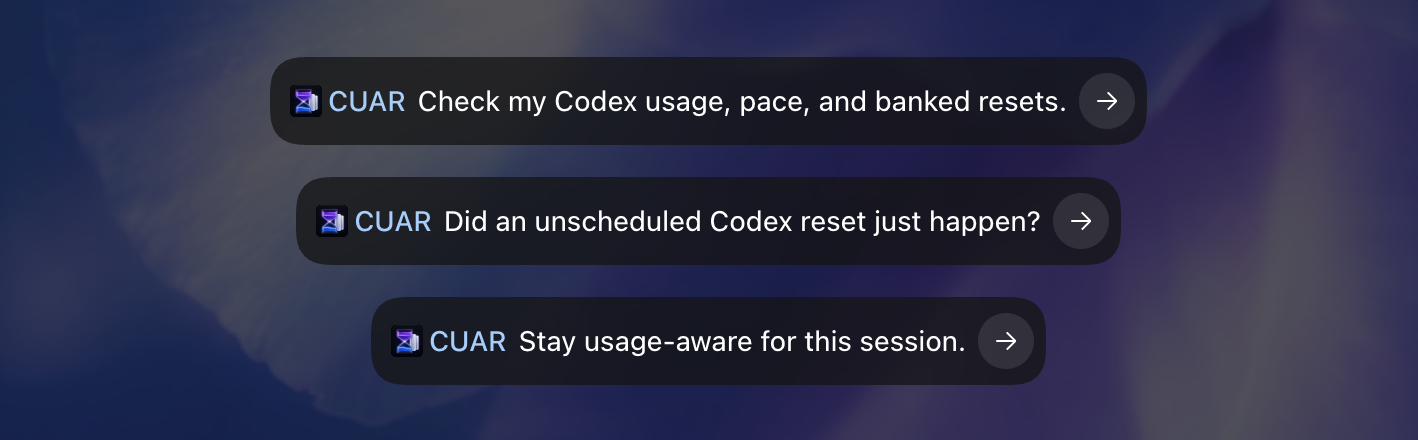
01 · Planning readout
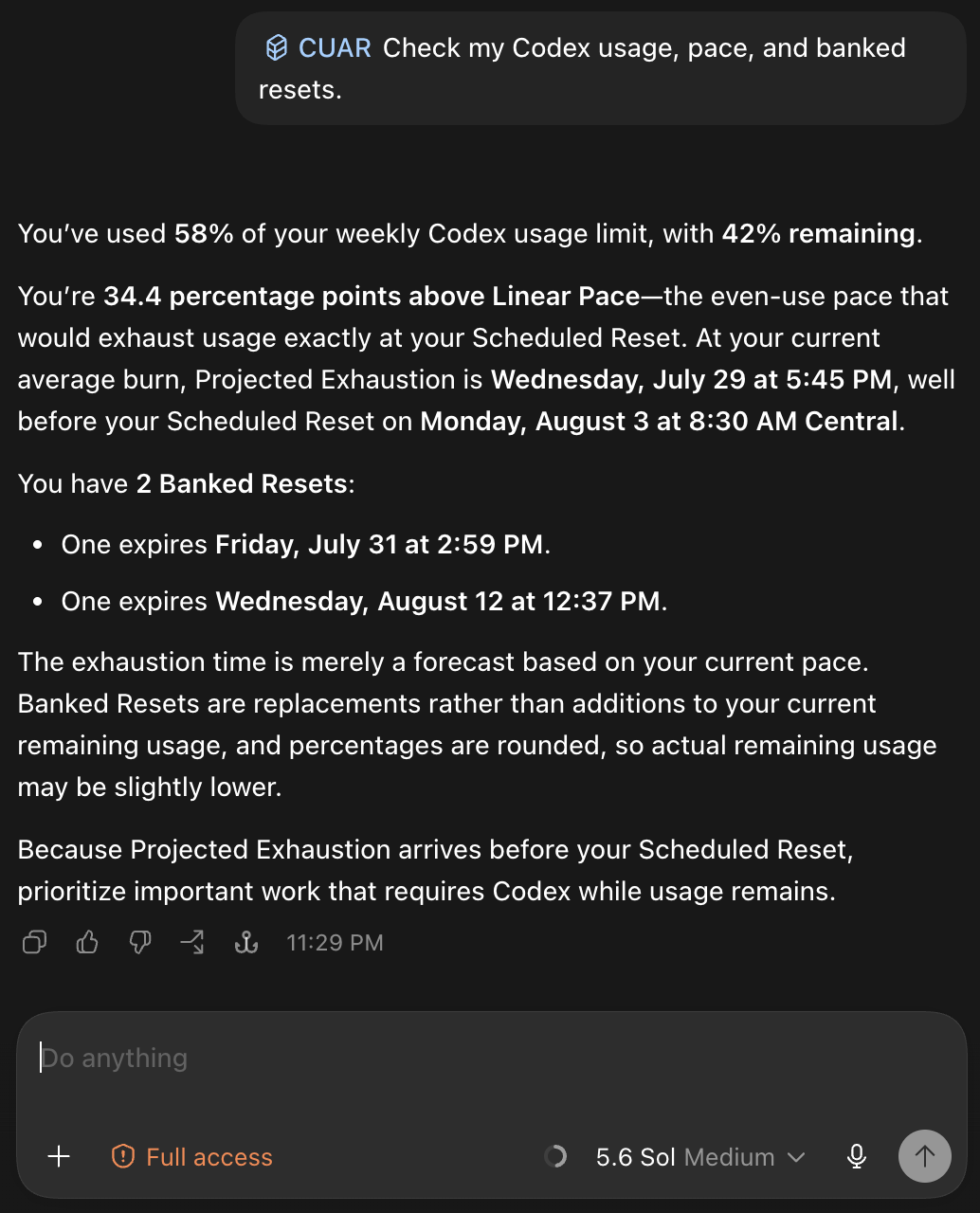
Start with your usage pace.
CUAR does not create a separate dashboard or hidden activity stream. It gives the active conversation one bounded, local planning context: your relationship to an even path through the active window.
Percent remaining and the Scheduled Reset establish the frame. The current delta from Linear Pace tells Codex how to advise from there.
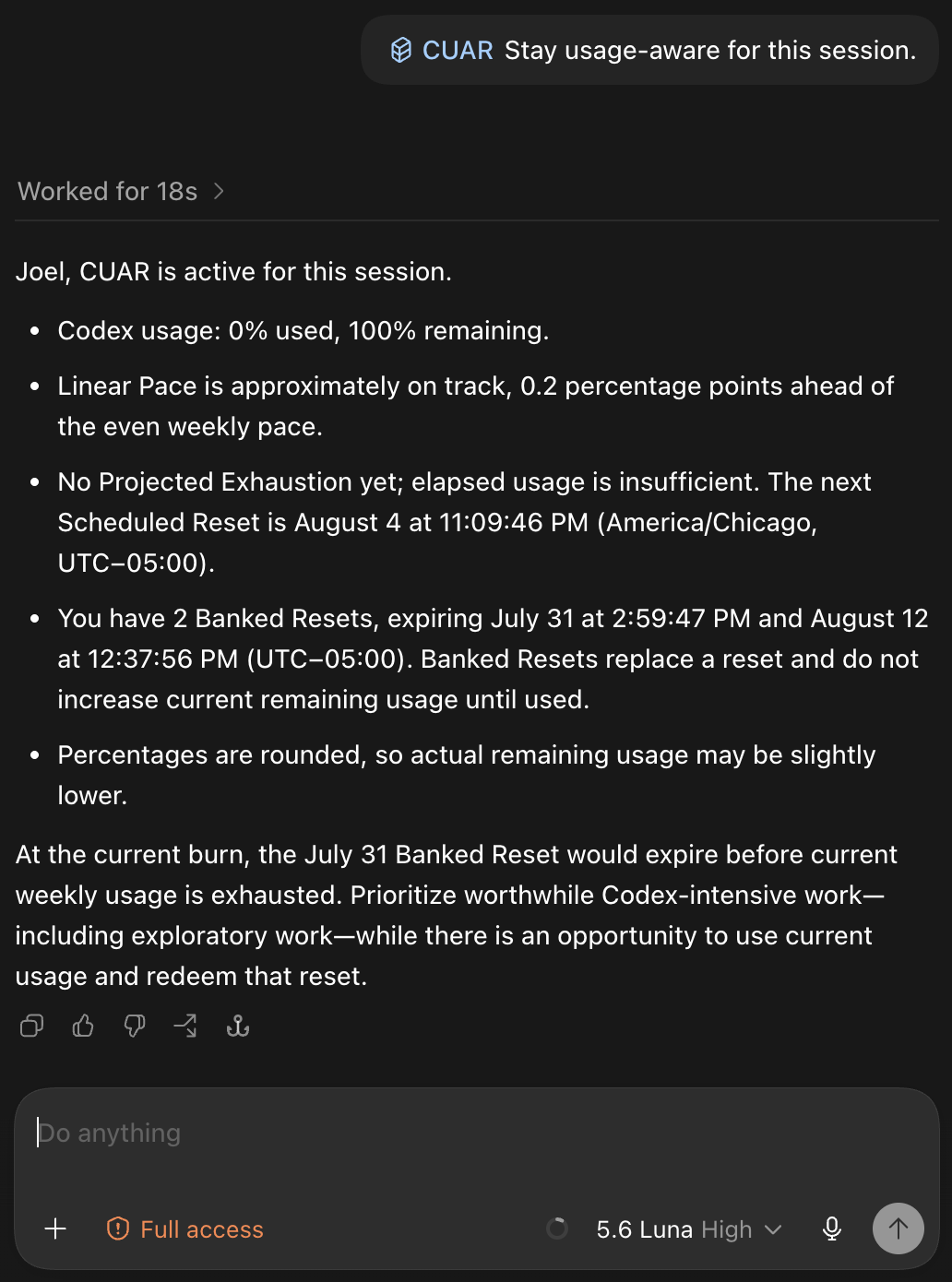
02 · Usage-aware sessions
Keep pace in the working context.
When a task is likely to use meaningful Codex usage, CUAR can make the current session usage-aware. It takes a fresh reading when activated, then gives Codex a concise set of pace and expiration facts to weigh as the work unfolds.
It does not turn into a monitor or interrupt every turn. It speaks up only when pace or an expiring Banked Reset changes the recommendation.
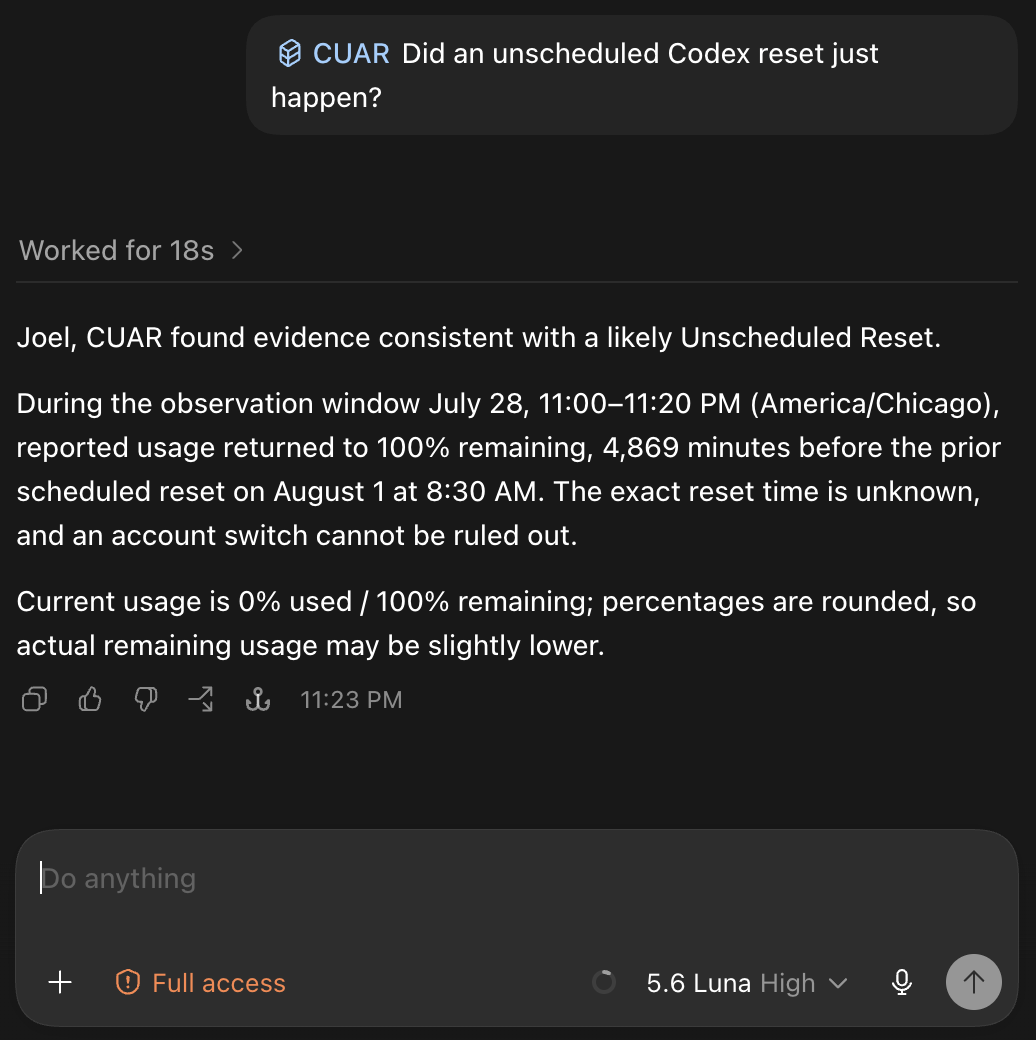
03 · Reset observation
Was that a reset?
CUAR compares a new report with its bounded, sanitized local record. When reported usage returns to 100% remaining before the prior Scheduled Reset, it can establish evidence consistent with a likely Unscheduled Reset.
That signal is derived entirely on the machine: the previous sanitized snapshot, the current read-only report, and the arithmetic between them. CUAR still does not invent the exact time or cause, and it never assumes another Unscheduled Reset is coming.
What it does
One read-only report. One useful comparison.
- Reads the current Codex usage window and returned Banked Reset details through the documented local App Server method.
- Calculates the delta between current usage and Linear Pace, plus Projected Exhaustion, deterministically—without asking the model to recalculate the numbers.
- Keeps one sanitized local snapshot and at most one recent derived reset observation for a bounded comparison across invocations.
- Never reads Codex authentication files, session logs, private ChatGPT endpoints, or raw App Server responses.
CUAR is not a hosted usage service and it cannot change a weekly usage limit. It is a local instrument for turning facts Codex already reports into a timely recommendation about the next piece of work.
What the signals mean
The useful fact is your delta.
Current weekly usage and the active Scheduled Reset establish the frame. Linear Pace compares usage with the percentage of that window already elapsed. The difference tells Codex whether the present course is above, below, or approximately on an even path.
That comparison is not a judgment, and it is not a promise. OpenAI reports some values at whole-percentage precision; CUAR treats displayed remaining usage as an upper bound and calls out when the rounding makes exhaustion imminent.
| Signal | What CUAR reports | What it does not claim |
|---|---|---|
| Linear Pace | The current delta between usage and an even path through the active window. | That being ahead of or behind pace is inherently good or bad. |
| Weekly usage + Scheduled Reset | The current percentage and active-window time that establish the pace comparison. | Whole percentages are exact measurements, or that a reset time is a personal recurring schedule. |
| Projected Exhaustion | A local estimate based on the current average burn. | When the weekly usage limit will definitely be exhausted. |
| Banked Reset Expiration | Returned counts and expiration details for replacement resets. | That a Banked Reset increases current remaining usage before it is used. |
| Unscheduled Reset | A cautious observation when reported usage returns unexpectedly before a prior Scheduled Reset. | The exact reset time or cause, or that another Unscheduled Reset can be predicted. |
Install
Install directly in Codex.
In the Codex Plugins directory, search for Codex Usage and Resets and choose Install.